V) Performance Simulator
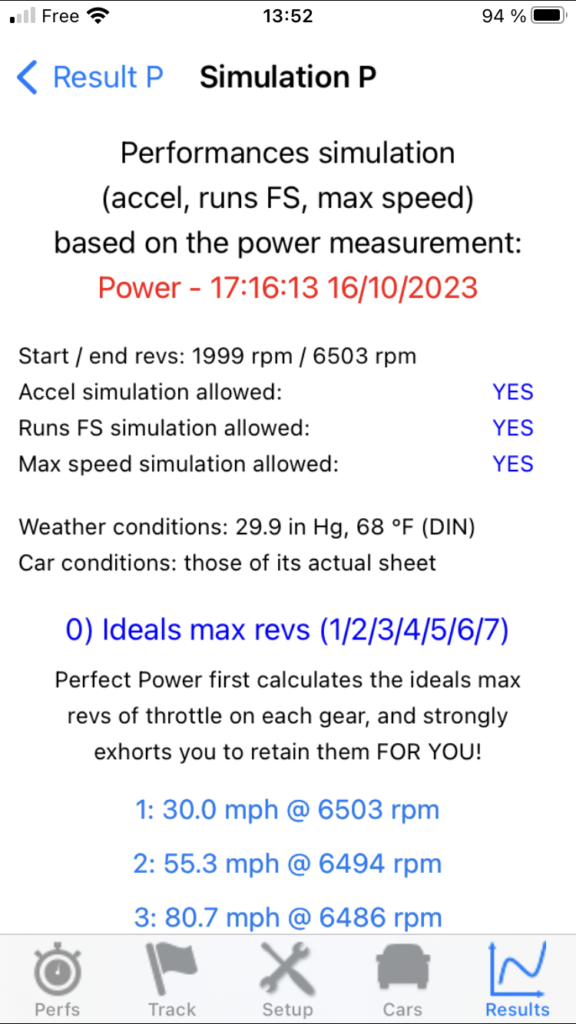
PerfectPower has an extremely sophisticated performance simulator, allowing you to simulate with maximum reliability all possible and imaginable performance of your car! It is based on the results of any power measurement that you indicate to it, and it will then recalculate, using the power / torque curves obtained and all the parameters that you have entered in the Car sheet, all the performance of your car, which fall into four types:
- 0) Ideal max revs to reach on each gear
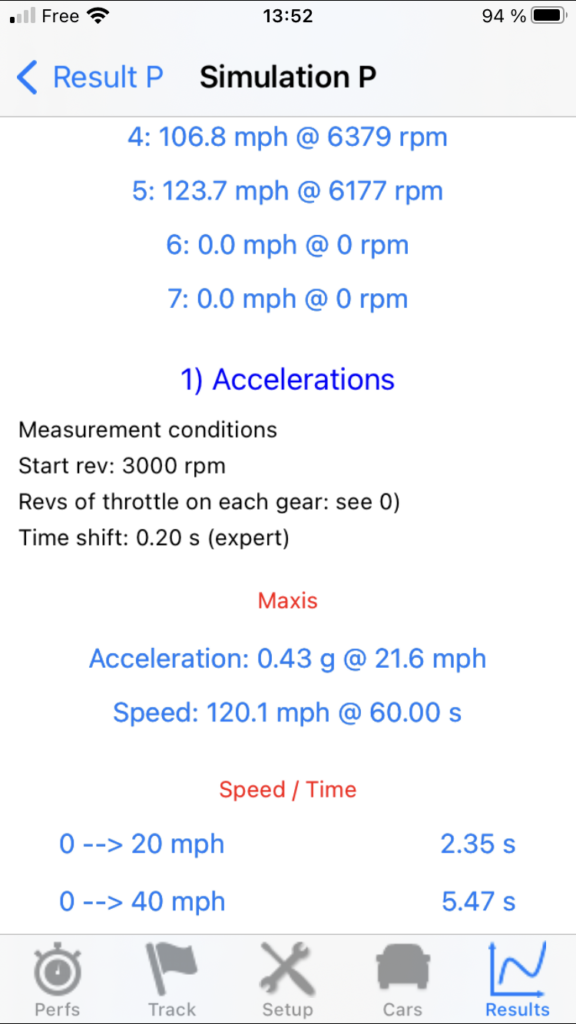
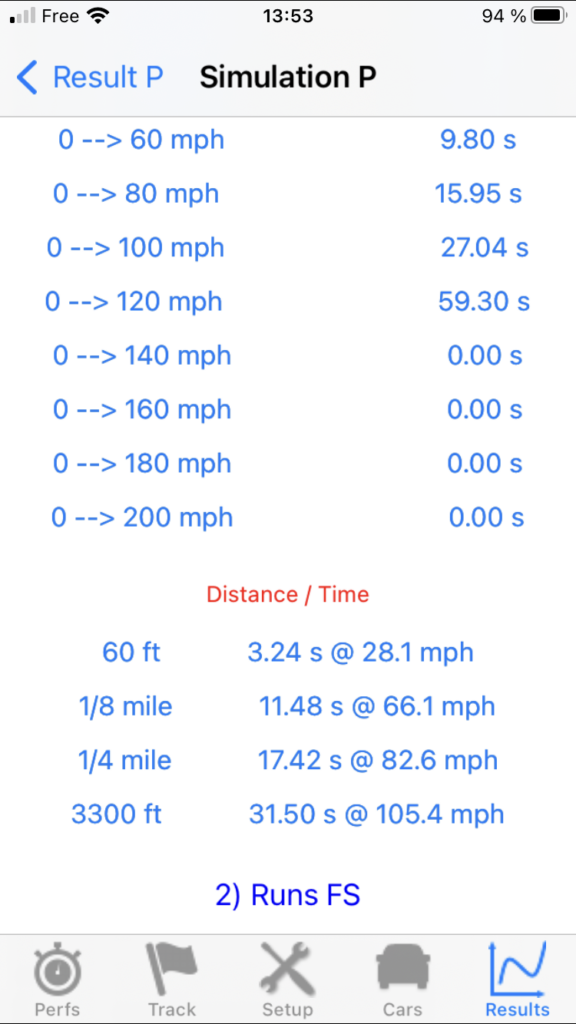
- 1) Accelerations
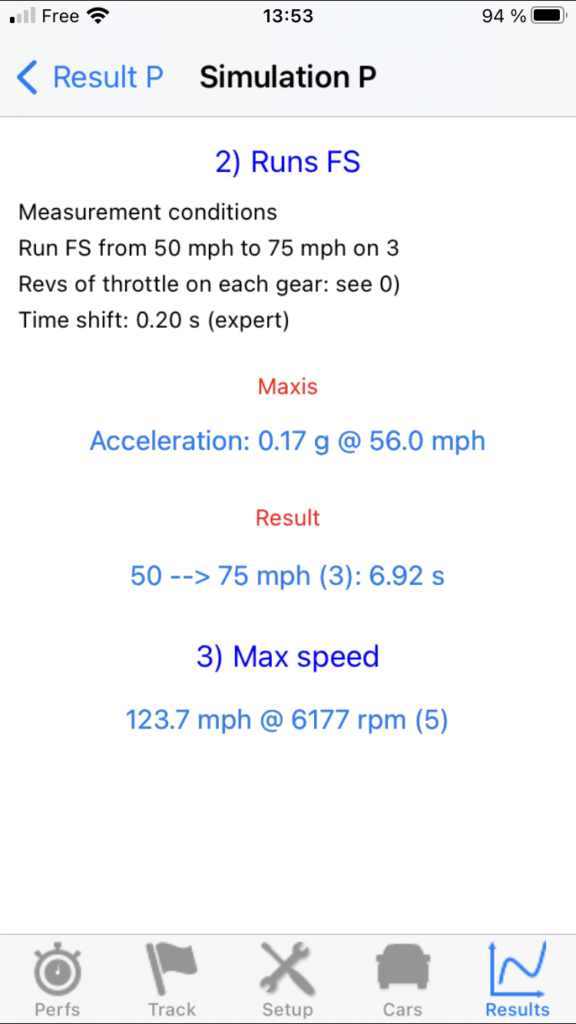
- 2) Runs flying start
- 3) Max speed
This simulator is accessible from any Power results sheet by pressing the Perf Simulation button located at the bottom of the sheet, and it will calculate and display all its results. Three remarks however:
1) The simulator indicates to you at the beginning of its report the simulations that it was able to carry out (accelerations, runs flying start, max speed) according to the revs at the start and end of the power measurement. Indeed, it cannot necessarily simulate all the measurements: for example, if your power measurement starts at 3000 rpm and stops at 3500 rpm, the simulator will not be able to simulate an acceleration since it will not know the power during any change of gear since the engine speed will drop below 3000 rpm at this time… but it will also not be able to simulate any run flying start that would take place over an engine speed range not completely included in the 3000-3500 rpm range for the same reason…
==> You must therefore think about this when you perform your power measurements, and therefore choose a range of revs wide enough to allow all the simulations, this range OBLIGATORILY having to include the rev of 3000 rpm, because PerfectPower simulates for the accelerations a clutch control at this rev when starting. Please note, however, that if you follow the guide to the letter (measurement data in chapter II-2-C), all of this is guaranteed!
2) The simulator then indicates the measurement atmospheric conditions (those of the DIN standard) as well as those of the car (those of its current sheet) used for its calculations. This has a very interesting consequence: it allows you to test the effects on performance of any car parameter change and to simulate any run flying start at will just by going back and forth in the Car sheet (for the change of car parameters) or in the Setup (for the runs flying start): the new simulation is performed INSTANTLY when returning to the simulator!
3) The simulator takes place in the measurement scheme of measurements performed on a flat, smooth, dry road, in a straight line, without wind, and with the tires warm and well inflated (manufacturer pressure), i.e. an ideal scheme. However, it can simulate EVERYTHING: measurements on a wet road, uphill or downhill, in bend, with wind, with over-inflated or under-inflated tires, etc… Also, if users are interested in the addition of such features in the future, it will be done!
Now here is the essential to remember about the simulation of the four types of performance!
0) Ideal max revs to reach on each gear
They represent the revs that must be “pulled” on each gear to obtain the best performance.
As you will be able to see when using the simulator, and contrary to certain preconceived ideas widespread even in the sporting automotive environment (it’s a shame!), the ideal max rev is often 500 to 1000 rpm higher than the max power rev according to the gear (especially in gasoline), and in any case always at least equal to the max power rev, and this is completely normal! The role of engine torque is surprisingly often very overrated in the notion of the ideal max rev to reach on each gear or even of acceleration capacities in general (if this was true, Diesels would be the absolute champions of accelerations, and we are obviously very far from the account…), so a future article will be published on this subject to clarify all this and restore power to its former glory!
1) Accelerations
The simulator achieves a maximum acceleration lasting 60 seconds performed by a PERFECT driver, capable of making a perfect start while remaining at the grip limit on starting in clutch control at 3000 rpm (and also after the start if the car is violent!), to push all its gears to the ideal max revs, and to change them in just 0.20 s, which is ultra fast with a manual gearbox. On the other hand, the grip coefficients used are those of old tires (90s), and they will be reviewed in a future update. But all in all, the best times you will do in your acceleration measurements should be very close to those calculated by the simulator, which represent, to summarize, optimal reference times but achieved with non-optimal tires and with a standard starting strategy not necessarily optimal for all cars!
2) Runs flying start
The simulator carries out a run flying start from a speed x to a speed y starting on a gear z, with x, y, and z mentioned in the Setup. Of course, if the speed y is unreachable, it will tell you!
3) Max speed
The simulator gives you the max speed you can reach, with the gear engaged and the corresponding engine speed.
Reminder: All these simulations are carried out within the ideal measurement scheme defined in remark 3.