


VII) Results
Go to the Results screen (accessible by pressing the Results icon -the 5th, on the right-).
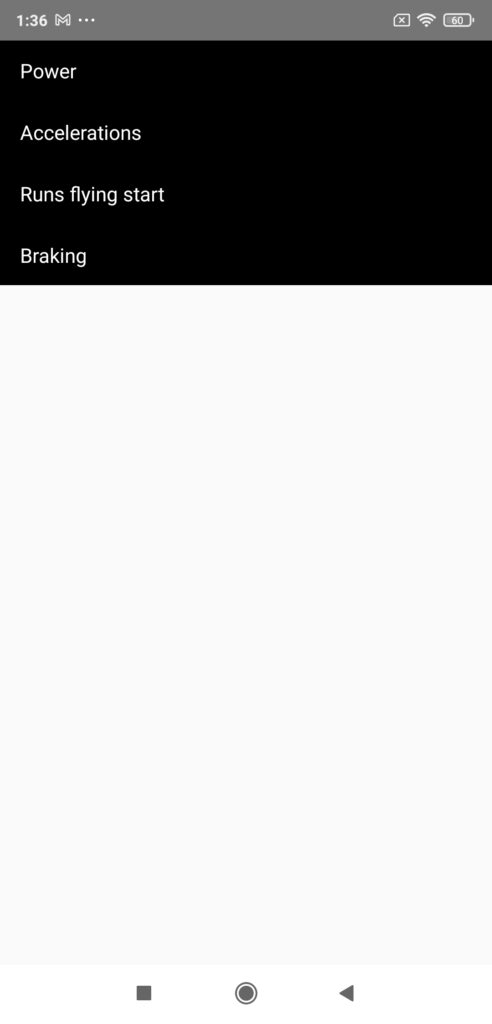
The list of the 4 main types of measurements (and saved in memory) is then displayed:
- Power
- Accelerations
- Runs flying start
- Braking
Click on the desired measurement type among these 4, and the list of the results for the selected car -the one displayed on the Perfs screen- is then displayed.
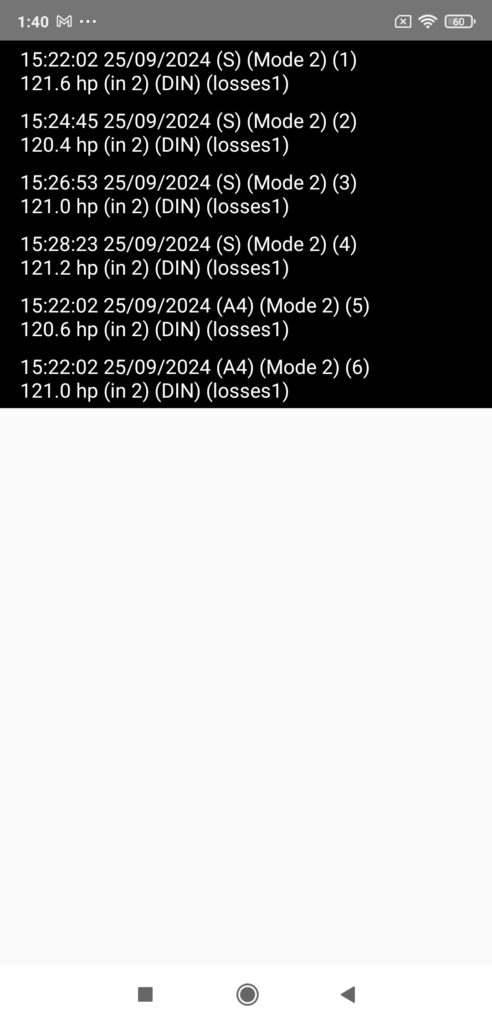
Each of the results in this list is identified by the date of the associated measurement, and several pieces of information (global or specific to the type of measurement) are also displayed:
Line 1 (global): Date of measurement, nature of measurement (S = single measurement, Ax = average of x measurements, x = 2, 3, or 4), measurement mode (Mode 1 = Accelerometer + GPS, Mode 2 = GPS only), registration number (from 1 to 50, maximum number of results allowed)
Line 2 (specific to the type of measurement):
- Power: max power, measurement gear, correction norm, and losses calculation mode (losses1 = calculation of losses on parameters, losses2 = calculation of losses by measure in coastdown)
- Accelerations: time at 400 m (1/4 mile) SS
- Runs flying start: type of run (start speed, end speed, gear engaged) and time achieved
- Braking: type of braking (start speed) and braking distance achieved
Example by choosing the power measurements (selected car Peugeot 307 1.6 16V)
1) Reading the results (sheet, graph)
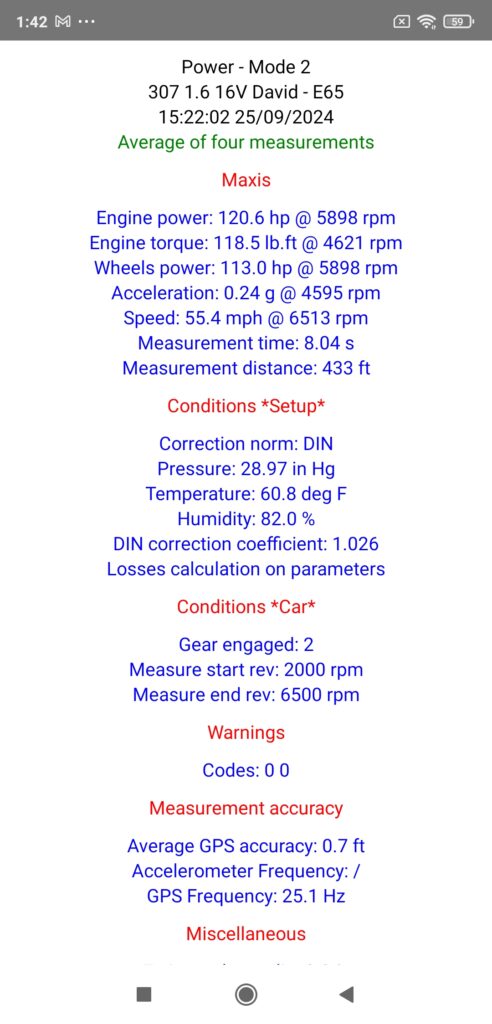
Click on the row corresponding to the desired result, and you will then access its sheet.
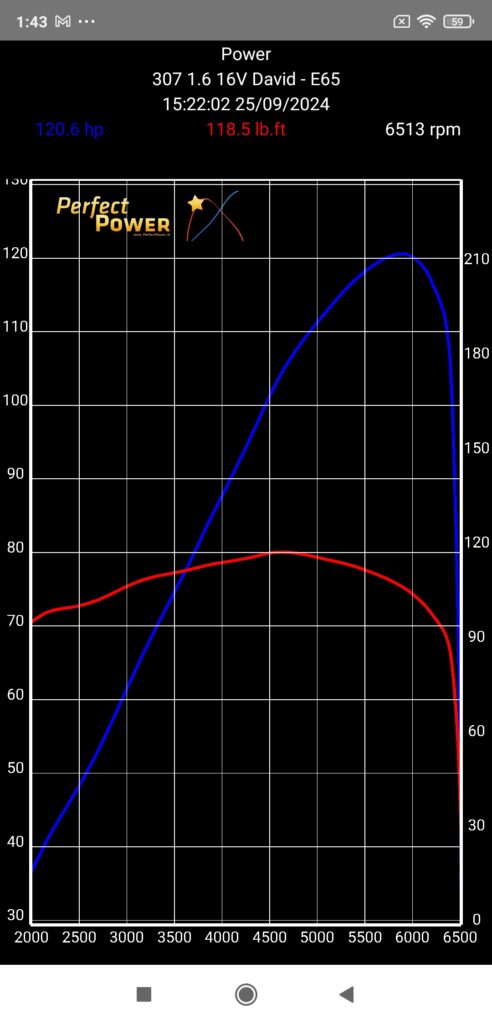
This sheet has a specific format for each type of measurement (power, accelerations, runs flying start, braking). The power and acceleration results have a graph accessible by pressing the Graphic button located at the bottom of the sheet.
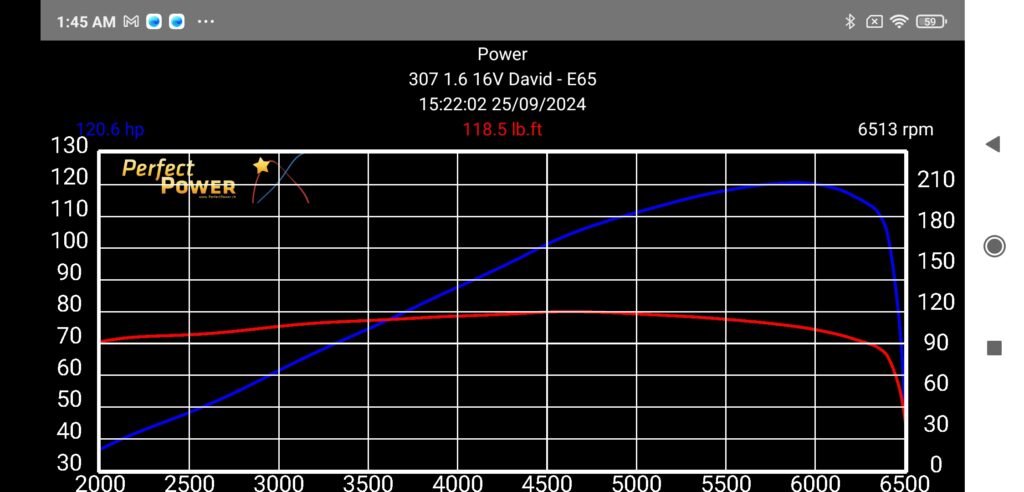
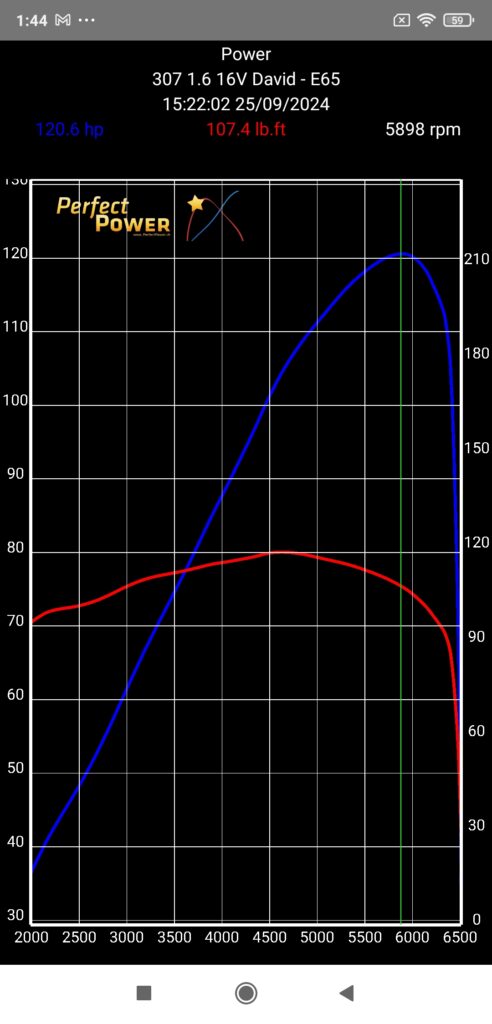
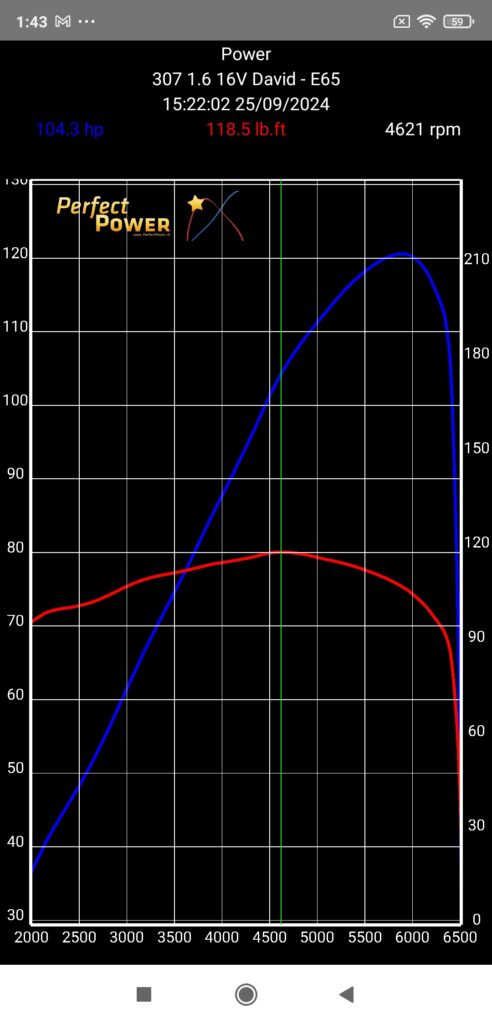
This graph includes two curves representing:
- Engine power and engine torque as a function of rev for power
- Acceleration and speed as a function of time for accelerations
The max values are summarized at the top of this graph.
This graph is also interactive: simply slide your finger over it to see a small green bar appear that moves with your finger, and the exact values of the selected measurement point are displayed in the reserved area at the top of the screen. To return to the results sheet, press the BACK button.
2) Recalculation of results on parameters (power)
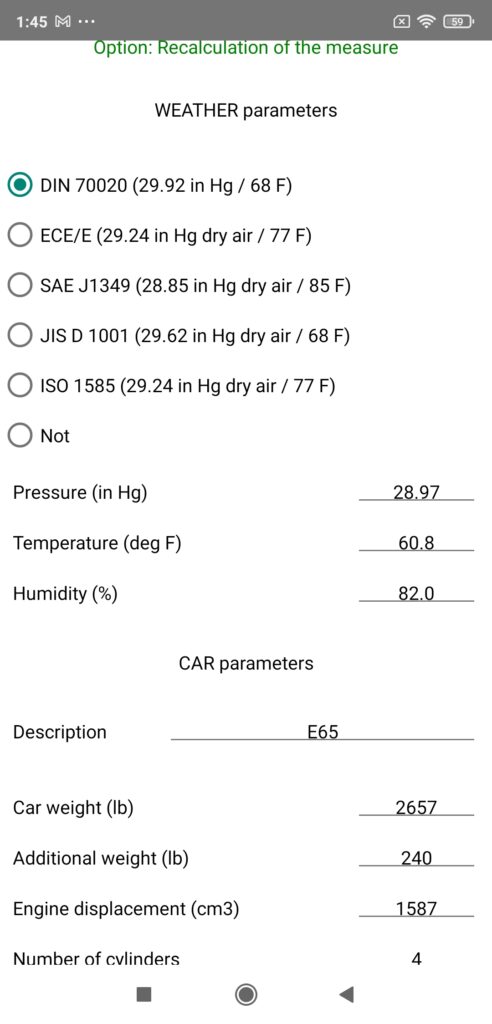
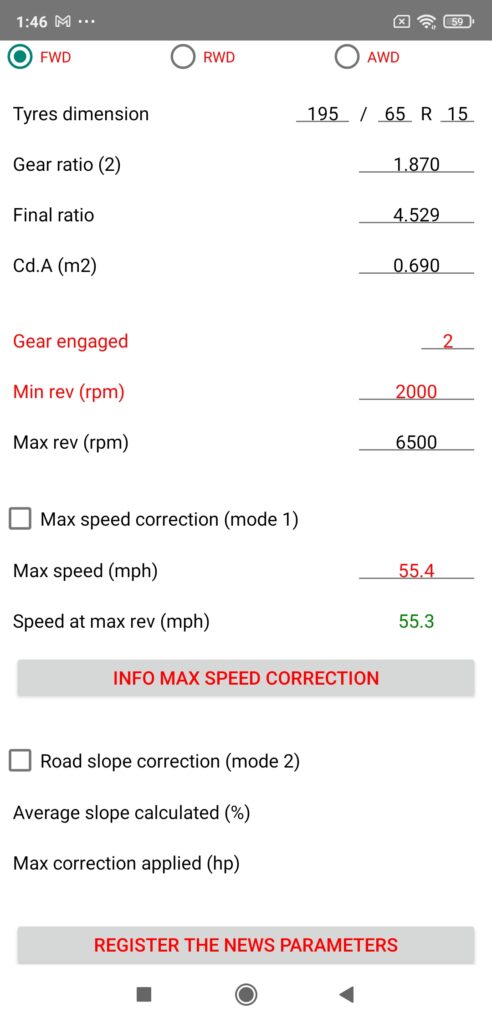
PerfectPower offers an extremely interesting function for recalculating the results on parameters for power measurements, which allows the application to recalculate these measurements AFTER they have been carried out, by modifying the parameters!
This function is located in any results sheet, in the “Option: Recalculation of the measure” part located below the results of the measure. To use it:
- Go to the results sheet of the measure you want to modify
- Modify the desired parameters (Weather and Car)
- As soon as the keyboard is closed, PerfectPower instantly recalculates all your results (power, torque, rev, etc…) over the entire measurement (without saving them however)!
- Press the “Register the new parameters” button located a little lower if you want to permanently save the measurement with its new parameters!
You can of course repeat the operation for any other measure that would have to be modified!
Note 1: The interest of this function is twofold: indeed, it not only allows you to correct parameters that would have been incorrectly entered when the Car sheet was initially created, but it also allows you to perform measurements straight away without making any initial configuration (very useful, for example, when you have very little time to measure a new car…), knowing that you will have plenty of time to make this configuration AFTER the measurements, with a clear head!
However, BE CAREFUL because a minimum initial configuration is still necessary: the type of transmission (front-wheel drive, rear-wheel drive, or all-wheel drive), the measurement gear (2nd or 3rd), and the min rev, but it is extremely quick and easy to do! These three parameters will be prohibited from any modification in the results sheets (that’s why they appear in red and their fields are locked…), so please remember that you will have to fill them in BEFORE measurement, otherwise these are the default parameters of the Car sheet used that will apply…
Note 2: As for the configuration of the Car sheet, pressing the blue button Done on the keyboard generates a process of checking the validity of the data entered (modified parameters in the present case).
3) Correction of results on max speed (power & accelerations) (mode 1)
PerfectPower offers an exceptionally effective function for correcting the results on max speed for power and acceleration measurements carried out in mode 1 (Accelerometer + GPS), which allows these measurements to be corrected in the event of poor GPS reception (or even GPS failure!)!
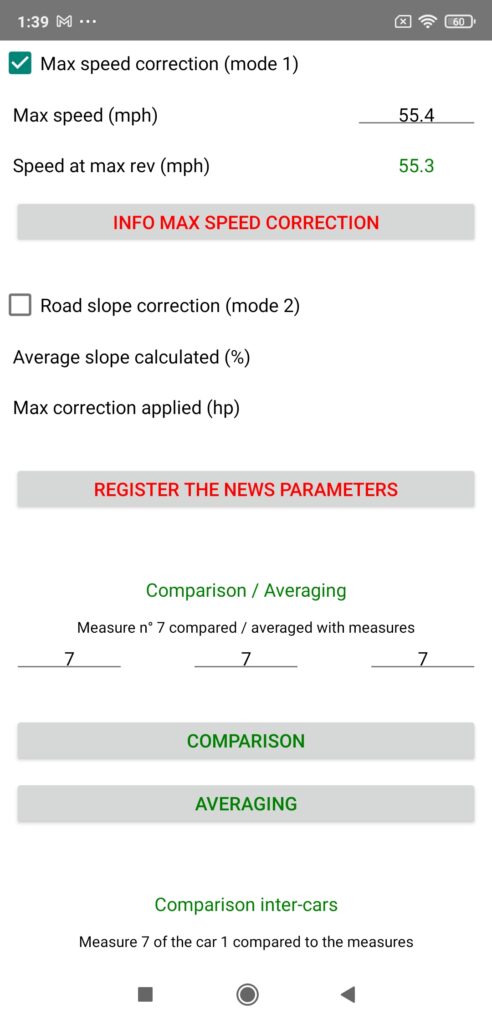
This function is located in any results sheet, at the bottom of the “Option: Recalculation of the measure” part, which is itself located below the results of the measure. To use it:
- Go to the results sheet of the measure to be corrected on max speed
- Check the “Max speed correction (mode 1)” box
- Enter in the “Max speed” field the actual max speed at the end of the measurement (you just need to determine it carefully: advice is given to you below on this subject in note 1)
- As soon as the keyboard is closed, PerfectPower instantly recalculates all your results (power, torque, rev, etc…) over the entire measurement (without saving them however), and this time they should be perfectly accurate!
- Press the “Register the new parameters” button located a little lower if you want to permanently save the measurement with its new configuration of actual max speed at the end of the measurement!
You can of course repeat the operation for any other measure that would seem suspicious or erroneous to you!
Note 1: How to carefully determine the actual max speed at the end of the measurement in your power measurements with a given car ?
- You should first get into the habit of ALWAYS stopping your measurements at the SAME max rev (the one you selected in the Car sheet), as already recommended in the Tips & Tricks section of the power measurements (chapter IV-1).
- Then, there are several ways to do this, but we will limit ourselves to the two that have the best speed accuracy / ease of testing ratio!!
1) The first consists of experimentally determining this speed by using a technique that greatly limits the risks of GPS inaccuracy thanks to a measurement at stabilized speed over a sufficient period of time: put the car at a rev close to the selected max rev and on the selected gear, then accelerate gently until you reach this selected max rev, and once reached, try to stabilize there for 2 or 3 s and simply note the actual speed (GPS speed) read at the top of the PerfectPower Perfs screen (it should be stable): that’s it, you should have your actual max speed at the end of the measurement to the nearest km/h & mph!
2) The second consists of simply using the “Speed at max rev” calculated by PerfectPower and displayed just below the “Max Speed” field! However, it is important to know that this is a theoretical speed (even if already calculated realistically by taking into account the tire’s rolling radius different from both the theoretical radius -higher…- and the radius under load -lower…-) having a usual margin of error of +- 2% due to the trio of uncertainties “Actual tires dimension / Wear level / Pressure & Temperature”, and it is always better to determine this speed experimentally using the first technique detailed above, thank you for your attention.
Note 2: How can this function for correcting results based on max speed be so effective, to the point of even being able to do without GPS evidently? It’s because, to simplify, it gives full power back to the phone’s accelerometer (incomparably more accurate and faster than any GPS…) which provides 95% of the measurement accuracy in mode 1, but with the help of a fundamental information (actual max speed at the end of the measurement) that the operator (you!) must provide and which helps it to perfectly recalibrate the results curves!
Note 3: As for the configuration of the Car sheet, pressing the blue button Done on the keyboard generates a process of checking the validity of the data entered (actual max speed at the end of the measurement in the present case).
IMPORTANT: Be careful though not to “misuse” this extraordinarily effective function by entering a max speed that would not be exact! Indeed, this function was created ONLY to correct a possible weakness in GPS reception on certain measurements, and it should therefore ONLY be used in this case! If you use it when your GPS reception is good, you will only degrade and not improve the accuracy of your results! Refer to the Tips & Tricks section of the power measurements (chapter IV-1) to find out if you should use it, thank you.
Example: Correction on max speed activated
4) Correction of results on road slope (power) (mode 2)
PerfectPower offers an extremely effective function for correcting the results on road slope for power measurements carried out in mode 2 (GPS only), which allows these measurements to be corrected according to the road slope!
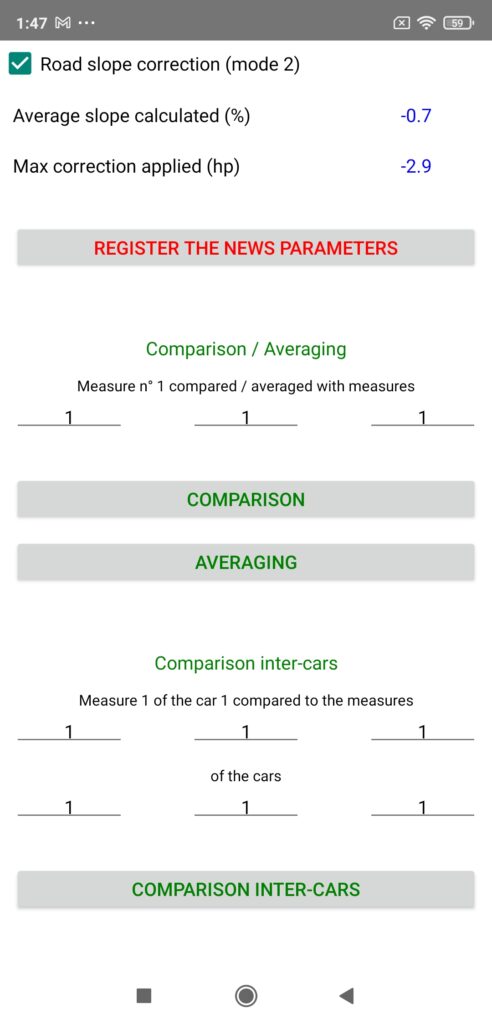
This function is located in any results sheet, at the very bottom of the “Option: Recalculation of the measure” part, which is itself located below the results of the measure. To use it:
- Go to the results sheet of the measure to be corrected on road slope
- Check the “Road slope correction (mode 2)” box
- PerfectPower then instantly recalculates all your results (power, torque, rev, etc…) over the entire measurement (without saving them however) by taking into account the road slope, AND it tells you the average road slope calculated and the max correction applied!
- Press the “Register the new parameters” button located just below if you want to permanently save the measurement with its new configuration taking into account the road slope!
You can of course repeat the operation for any other measure that would have to be corrected on the road slope!
IMPORTANT: The use of the RaceBox Mini or Micro (the only external GPS authorized in mode 2, all information on this subject in chapter I-0-B) is essential to use this function, the internal GPS of phones being much too inaccurate for an accurate correction!
Moreover, this function is NOT a magical function allowing to exempt you from performing measurements in both directions of the road since although it compensates with impressive efficiency for the effects of road slope, on the other hand it does not compensate for those of the wind (just as important!) AND therefore it remains ESSENTIAL to perform measurements in both directions of the road and average them to obtain perfectly reliable results, thank you for your understanding!
All info on this subject in the FAQ (question 5) (link coming soon).
Example: Correction on road slope activated
5) Compare and/or average results from a same car
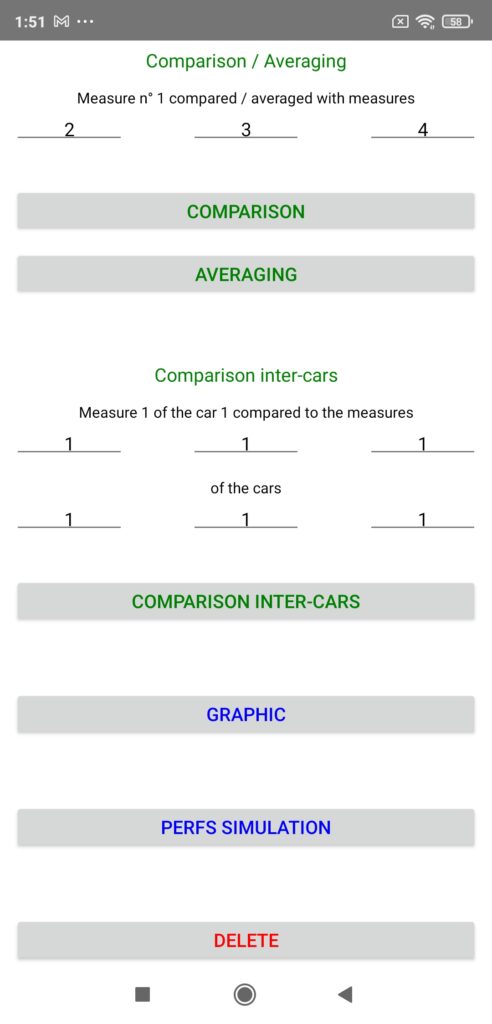
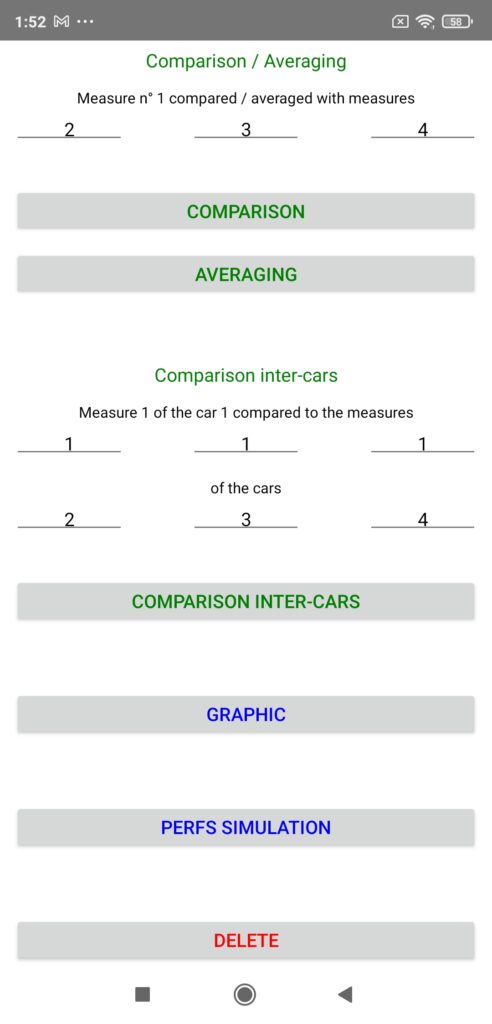
It is possible with PerfectPower to compare and/or average the results of two to four measurements of the same type for a same car. Simply access the results sheet for one of the measurements to be compared and/or averaged (this measurement will be the reference measurement), then select in the Comparison / Averaging part located at the bottom of the sheet the number of the other measurements to be compared and/or averaged, and finally press the appropriate Comparison or Averaging button: you then access the comparison or averaging sheet of the chosen measurements. You then return to the results sheet of the reference measurement by pressing the BACK button.
Note 1: You must ensure the compatibility of the measurements to be compared and/or averaged:
Comparison
- 1) Power measurements: They must have been performed using the same correction norm
- 2) Acceleration measurements: No incompatibilities
- 3) Runs flying start measurements: They must be EXACTLY of the same type (same start speed, same end speed, same gear engaged)
- 4) Braking measurements: They must be EXACTLY of the same type (same start speed)
Averaging
- 1) Power measurements: They must have been performed using the same measurement mode, be single measurements (not already averaged), have EXACTLY the same SETUP parameters (correction norm, pressure, temperature, humidity, losses calculation mode) & CAR 1 (car weight, additional weight, engine displacement, number of cylinders, transmission type, tires dimension, gear ratio, final ratio, Cd.A) & CAR 2 (measurement gear, min rev, max rev), and finally have the same road slope correction status! However, they can have a different max speed correction status.
- 2) Acceleration measurements: These must have been performed using the same measurement mode and be single measurements (not already averaged)
- 3) Runs flying start measurements: These must be single measurements (not already averaged), and they must be EXACTLY of the same type (same start speed, same end speed, same gear engaged)
- 4) Braking measurements: These must have been performed using the same measurement mode and be single measurements (not already averaged), and they must be EXACTLY of the same type (same start speed)
However, you don’t really have to worry about this since if you select incompatible measurements, PerfectPower will detect this and won’t select them.
Note 2: As for the configuration of the Car sheet, pressing the blue button Done on the keyboard generates a process of checking the validity of the data entered (numbers of the measurements to be compared and/or averaged in the present case).
IMPORTANT: When averaging measurements, be aware that it is possible to generate a new official result based on the averaged result! Simply press the GENERATE A NEW RESULT button located at the very bottom of the averaged result sheet, and a new official result constituting the average of the source measurements used is created with a new number and the date of the reference measurement result!
This new averaged official result is added to the list of classic results, and it has all the characteristics of them. The only visible difference with classic results is the mention Ax (= average of x measurements, with x = 2, 3, or 4) instead of S (= single measurement) in the list of results, and the reminder of its averaged and non single nature in its own sheet with the mention “Average of x measurements” instead of “Single measurement” in the header.
Generating a new official result constituting the average of several measurements is extraordinarily interesting, because it allows you to:
- Formalize your measurement results with a single sheet & graph, as if a single measurement had been performed!
- Delete then all the source measurements used to generate this new official result, freeing up memory space!
Example: Comparison of measurements 1, 2, 3, and 4 of the selected car
6) Compare results from different cars
It is also possible with PerfectPower to compare the results of two to four measurements of the same type but with different cars. Simply access the results sheet for one of the measurements to be compared (this measurement will be the reference measurement), then select in the Comparison inter-cars part located at the bottom of the sheet the number of the other measurements to be compared with for each the number of the associated car, and finally press the Comparison inter-cars button: you then access the comparison sheet of the chosen measurements for the different cars. You then return to the results sheet of the reference measurement by pressing the BACK button.
Note: The same comparison rules apply to classic comparisons (rules defined a little higher in notes 1 and 2 of chapter 5) and inter-cars comparisons.
Example: Comparison of measurement 1 of cars 1 (the selected car), 2, 3, and 4
7) Export power results (sheet, graph) by email
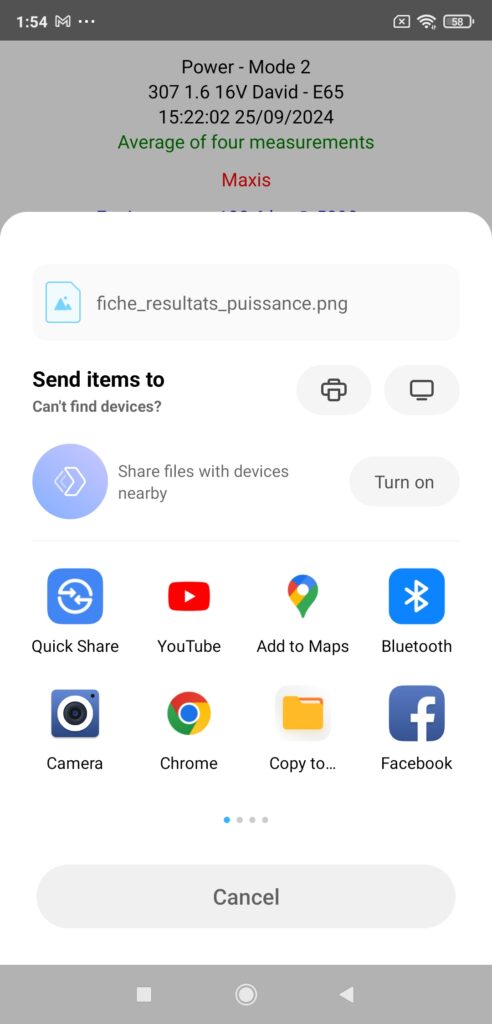
With PerfectPower, you can export by email results sheets and power measurement graphs, and this both for classic results and for comparisons and averagings of results.
To do this, simply long-click at the very top of the screen on the first line of text in the results sheet or graph you want to export, and PerfectPower will offer you a selection of email applications allowing this export.
Select the one that suits you best (gMail for example), enter your email address, then click on “Send”: the sheet or graph will be immediately sent to your inbox as a PNG image file.
8) Delete a result
As for cars, you can also delete a result at any time: from the sheet of the result to be deleted, make a long click on the “DELETE” button located at the very bottom. You can then delete other results by repeating the same operation.
Warning: This deletion operation is irreversible!